

Last Updated on October 13, 2026
People who love cooking are always curious about kitchen appliances that promise faster meals with less effort. A NuWave oven is one of those appliances that can look almost too good to be true. How can a countertop cooker roast chicken, brown vegetables, and even handle some foods straight from the freezer?
The explanation is simpler than the advertising makes it sound. The classic NuWave infrared oven combines radiant heat, circulating hot air, and heat transferred through its cooking rack or pan. These methods work together to cook and brown food without requiring a large conventional oven for every meal. If you’re wondering how the NuWave oven works, here’s what actually happens inside it—and where its limits are.
What Is a NuWave Oven, and How Does the NuWave Oven Work?
A NuWave oven is a countertop electric cooking appliance. The original dome-style NuWave ovens became known for their transparent covers, raised cooking racks, and combination of three heat-transfer methods: infrared radiation, convection, and conduction.
Once you select the time and temperature, the heating element produces heat while a fan moves hot air around the food. At the same time, hot surfaces such as the rack or pan transfer heat wherever they touch the food. The combination can help brown the outside while the center cooks through.
Not every NuWave-branded product uses exactly the same design. The classic Pro and Pro Plus infrared ovens differ from newer Bravo countertop ovens and Brio air fryers. Always check the instructions for your specific model before choosing a cooking temperature, rack position, or accessory.
Infrared, Convection, and Conduction: The Three Cooking Methods
Infrared, convection, and conduction are the three heat-transfer methods commonly associated with the classic NuWave oven. They aren’t mysterious cooking forces. They’re familiar forms of heat used in different ways.
1. Conduction: Heat Through Direct Contact
Conduction happens when heat travels from one material into another through direct contact. Think of a piece of meat resting in a hot frying pan: the pan heats the surface touching it. In a NuWave oven, a hot cooking rack, tray, or pan can transfer heat where it touches the food.
Because the rack touches only part of the food, conduction is just one piece of the cooking process. The oven also depends on radiant heat and moving air to heat areas that aren’t in direct contact with a surface.
2. Convection: Hot Air Circulating Around Food
Convection uses moving air to transfer heat. A fan circulates heated air around the food, making it easier for hot air to reach several sides of a chicken breast, potato, or piece of fish. This movement can improve browning and reduce uneven cooking compared with an oven that relies mostly on still air.
However, airflow is not a guarantee that every part will cook identically. Large foods, crowded racks, and blocked air passages can still produce uneven results. Giving food enough space and turning it when the instructions recommend it can help.
3. Infrared: Radiant Heat From the Heating Element
Infrared is invisible electromagnetic radiation emitted by warm and hot objects. In a NuWave infrared oven, radiant heat travels from the heating element toward the food and surrounding surfaces. It helps heat and brown exposed areas, working alongside circulating air.
You may see descriptions suggesting that infrared cooks meat completely “from the inside out.” That isn’t a precise explanation of the process. The surface absorbs energy, and heat then moves inward. The center still needs enough time to reach a safe temperature—especially with thick cuts of meat.
Why Can a NuWave Oven Cook Faster Than a Regular Oven?
In some situations, a smaller cooking chamber, direct radiant heat, and circulating hot air can shorten the total time needed for a meal. Certain classic NuWave infrared ovens also let you start cooking without a separate preheating step, depending on the recipe and model.
But there is no reliable rule that a NuWave oven always cooks 25%, 50%, or any other fixed percentage faster than a conventional oven. Results depend on the food, its thickness, starting temperature, selected heat setting, and whether the full-size oven would need to preheat.
The difference is often most noticeable with everyday meals such as chicken pieces, fish fillets, roasted vegetables, and smaller portions. For a very large dish, a conventional oven may still be more practical.
How to Use a NuWave Oven: A Simple Step-by-Step Guide
- Choose the correct rack and accessory. Put the rack, liner pan, and any other required parts in place according to your model’s manual.
- Prepare the food. Season it as you normally would. A little oil may help with browning, but deep-frying oil is not needed.
- Arrange the food with space around it. Avoid tightly crowding the rack because hot air needs room to move.
- Set the cooking time and temperature. Start with a recipe written for your model, then adjust as needed for food size and thickness.
- Check partway through cooking. Turn or reposition the food if the recipe recommends it, especially for even browning on the underside.
- Confirm the internal temperature. Use a food thermometer rather than relying only on the color of the outside.
- Let the appliance cool before cleaning. Disconnect the power and follow the manufacturer’s instructions for washing removable parts.
Many NuWave models can cook certain frozen, unstuffed foods without thawing first. That does not mean all frozen foods are suitable for every NuWave oven. Follow the product’s cooking directions, allow extra time when necessary, and check the temperature in the thickest part. Always follow package instructions for frozen, stuffed, breaded poultry products.
How Does the NuWave Oven Work? Watch the Video
With the model’s controls, you can set a time and temperature, stop cooking to check progress, or make adjustments. The exact controls vary by model. A classic infrared oven can roast, bake, broil, grill, and reheat many foods; some models also support low-temperature cooking or dehydrating. Check the manual before assuming every feature is available.
What Does Convection Oven Mean?
A conventional oven heats food using hot air and heat radiating from its walls or heating elements. A convection oven adds a fan to circulate heated air inside the cooking chamber.
Some convection ovens have a separate heating element near the fan, but others do not. So it is incorrect to say every convection oven must have a third heating element at the back. The defining feature is the fan-assisted movement of hot air.
What Does a Convection Oven Do?
Moving hot air helps a convection oven transfer heat efficiently and can make browning more consistent. For instance, when roasting a turkey or baking cookies on more than one rack, convection may reduce some hot and cool spots. Even so, oven placement, pan size, and the food itself still affect the final result.
Some recipes call for reducing a conventional-oven temperature by about 25°F when switching to convection, while others use the same temperature and a shorter time. Treat that as a starting point—not a universal rule—and follow the recipe or oven manual.
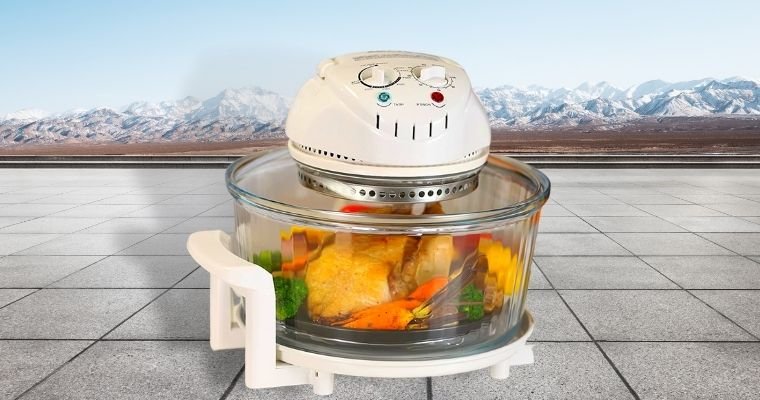
A convection oven can be particularly useful for roasting vegetables, crisping chicken skin, or baking trays of cookies. It’s less helpful when strong airflow disturbs delicate batters or dries out foods that need gentle heating. For those recipes, a regular bake setting may work better.
For practical settings and food ideas, see our convection oven cooking times and NuWave recipes.
Convection vs. Conduction: What’s the Difference?
Both methods transfer heat, but they do it differently. Conduction works through contact with a hot surface; convection relies on movement of heated air or liquid. A modern oven often uses both, along with radiation from its heating elements.
| Feature | Conduction | Convection |
|---|---|---|
| How heat moves | Direct contact | Moving hot air or liquid |
| Kitchen example | Food touching a hot pan | A fan circulating hot air in an oven |
| Main benefit | Direct surface heating | Heat reaches exposed surfaces more consistently |
What Is a Convection Oven Used For?
A convection oven is useful for foods that benefit from circulating hot air. The table below makes the distinction between regular convection cooking and the separate functions found on some combination microwave ovens.
| Cooking mode | What it does | Good examples |
|---|---|---|
| Convection baking or roasting | Circulates hot air around food | Chicken, roasted vegetables, cookies, potatoes, lasagna |
| Broil or grill | Uses strong radiant heat near food | Browning tops, kebabs, thin cuts of meat |
| Microwave (combination models only) | Uses microwave energy, not ordinary convection heat | Quick reheating, drinks, appropriate microwave-ready meals |
A standard NuWave infrared oven is not a microwave. It doesn’t automatically have a microwave mode just because it can reheat leftovers. Likewise, steaming or boiling requires suitable cookware and the correct model-specific method; those functions should not be assumed from the word “convection.”
What Can You Cook in a NuWave Oven?
There is plenty of variety, especially if you enjoy roasted or browned food. Depending on your oven model and accessories, you may be able to prepare:
- Poultry: chicken pieces, wings, and smaller whole birds that fit within the approved capacity.
- Meat and fish: chops, burgers, salmon, and other suitable cuts.
- Vegetables: potatoes, carrots, peppers, broccoli, and other roast-friendly vegetables.
- Baked foods: small cakes, rolls, biscuits, and casseroles in oven-safe cookware.
- Convenience foods: suitable frozen fries, breaded snacks, and reheated leftovers.
Cooking time will vary. A large turkey may fit certain dome-style ovens with an extender ring, but not every model has the necessary clearance or capacity. Check your manual before attempting a large roast.
If you’re looking for ideas rather than cooking theory, start with chicken, fish, or vegetables that fit comfortably on your rack. Follow a recipe developed for your oven model, then adjust for the thickness and amount of food.
NuWave Oven vs. Air Fryer: Which One Should You Choose?
A traditional basket-style air fryer and a classic dome-style NuWave oven both use hot air to cook food, but their designs and accessories can make them more convenient for different jobs. Neither type is automatically faster, cheaper, or more durable across every model.
| Feature | Classic NuWave Infrared Oven | Typical Basket Air Fryer |
|---|---|---|
| Cooking method | Infrared radiation, convection, and conduction | Primarily fan-forced hot air, plus radiant and contact heat |
| Food placement | Open rack beneath a dome | Removable basket or tray |
| Best suited to | Roasts and varied oven-style dishes that fit the rack | Quick batches of fries, wings, vegetables, and snacks |
| Capacity | Depends on dome, rack, and extender ring | Depends on basket size; large and dual-basket models exist |
| Browning and crisping | Good potential; food position matters | Often convenient for smaller crispy portions |
| Cleaning | Dome, rack, and drip pan may need separate cleaning | Usually basket and tray; coating care varies |
| Temperature range | Varies by NuWave model | Varies by manufacturer and model |
| Price and longevity | Depends on the exact model and condition | Depends on model, components, and maintenance |
If you often roast larger cuts of meat or like seeing the food under a transparent dome, the classic NuWave design can be appealing. If your routine is mostly smaller batches of fries, vegetables, or chicken wings, a basket air fryer may be more convenient. The right choice depends on what you actually cook.
For a deeper explanation of the overlap between these appliances, read whether a NuWave oven can be used as an air fryer. If you’re comparing current basket-style appliances, our air fryer buying guide is a useful starting point.
Is Cooking in a NuWave Oven Healthier?
Using a rack can allow some rendered fat to drip away from meat, and cooking with hot air may require less added oil than deep-frying. Those can be helpful advantages if you want to adjust the way you prepare certain meals.
Still, the appliance itself does not automatically make food healthier. The ingredients, portion size, amount of added fat, and overall diet matter far more. Nor does using electric heat make the appliance completely free of environmental impact; its electricity use depends on power consumption and cooking time.
Cleaning and Safety Tips for a NuWave Oven
- Allow the oven to cool before removing the dome, rack, or liner pan.
- Do not immerse the electrical power head or heating assembly in water.
- Check your exact manual before putting parts into the dishwasher; the safe parts differ by model.
- Do not block vents, crowd the cooking rack, or use materials that are not approved for the oven.
- Measure food temperature with a thermometer. Poultry must reach 165°F (74°C); whole cuts of beef, pork, veal, and lamb require at least 145°F (63°C) with a three-minute rest; fish requires 145°F (63°C).
If your model has a probe, use it according to the manufacturer’s directions. A built-in probe is useful, but you still need to check that it is placed properly in the thickest part of the food.
Frequently Asked Questions
1. Does a NuWave oven use infrared or convection heat?
The classic NuWave infrared oven uses both, along with heat transferred through direct contact. Newer NuWave products can use different heating systems, so the exact model matters.
2. Do you need to preheat a NuWave oven?
Many classic infrared models were designed to cook without a separate preheat period. Other NuWave ovens and recipes may require preheating. Follow your model’s instructions.
3. Can you cook frozen chicken in a NuWave oven?
Some models can cook suitable frozen, unstuffed chicken, but cooking usually takes longer. Follow the correct model and package instructions, and verify that the thickest part reaches 165°F. Do not assume every frozen poultry product is suitable.
4. Can you put aluminum foil in a NuWave oven?
Some classic models permit foil or oven-safe metal containers in specific positions. Foil can interfere with airflow or shielding of radiant heat, so use it only as your model’s manual permits. Never let it contact a heating element.
5. Is a NuWave oven the same as a microwave?
No. A classic NuWave infrared oven uses radiant heat, moving air, and contact heat rather than microwave energy. Some separate combination appliances include microwave functions, but they are different products.
6. Is a NuWave oven better than an air fryer?
Neither wins every comparison. A dome-style NuWave can be useful for rack-based roasting, while a basket-style air fryer may be easier for quick, smaller portions. Compare the exact models, their capacity, and how much counter space you have.
Final Thoughts
Understanding how a NuWave oven works makes its cooking results a lot less mysterious. Radiant heat helps brown food, circulating hot air moves heat around it, and direct contact transfers heat from the rack or pan. Together, these methods make the classic NuWave oven a flexible choice for many everyday recipes.
Just remember that cooking speed, available functions, and temperature limits vary by model. Start with the manufacturer’s cooking guide, leave space for airflow, and use a thermometer for meat and poultry. Those simple habits matter more than any advertising promise.